India’s Warehousing Revolution: From Shadows to Spotlight
India’s real estate landscape is experiencing a profound transformation. While residential towers and commercial office spaces traditionally dominated headlines, the warehousing market has emerged as a powerhouse, valued at USD 60.42 billion in 2024 and projected to grow at a CAGR of 10.50% through 2034. This isn’t merely about constructing storage facilities it’s about building smart infrastructure that powers the nation’s economic engine.
The surge of capital from the world’s leading fund houses proves this isn’t speculation it’s strategic investment in a sector primed for exponential growth. Institutional investment in India’s warehousing assets skyrocketed from $645.8 million in 2023 to $1.96 billion in 2024, representing a remarkable 203% year-over-year increase. This dramatic influx of institutional money is formalizing the market and establishing new industry benchmarks.
Why Global Investors Are Betting Big on Indian Warehousing
The Perfect Storm of Structural Trends
The institutional investment surge isn’t coincidental it’s driven by converging forces that have made India’s logistics market exceptionally attractive:
GST Revolution: The implementation of the Goods and Services Tax created a unified national market, accelerating the transition from fragmented, inefficient warehouses to large-scale, modern logistics parks. This policy shift fundamentally restructured how goods move across India.
E-Commerce and Quick Commerce Explosion: India’s quick commerce market was valued at $3.34 billion in 2024 and is projected to reach $9.95 billion by 2029. Companies like Blinkit, Zepto, and Swiggy Instamart are revolutionizing retail with 10-minute deliveries, requiring dense networks of strategically located dark stores and fulfillment centers.
Record Absorption Rates: The sector witnessed record absorption of 44.9 million square feet in 2024, marking a 19% increase over the previous year. Notably, Mumbai alone accounted for 18.6 million square feet with an 82% growth, driven by improved connectivity through Navi Mumbai airport and the quick commerce boom.
Stable Returns: Unlike volatile asset classes, well-located warehouses with quality tenants provide predictable, long-term rental income through multi-year lease agreements a compelling proposition in uncertain economic times.
The Giants Behind India’s Warehousing Transformation
The world’s financial elite have made their presence felt in Indian logistics. Each brings unique strategies, but all share one vision: capitalizing on India’s consumption and manufacturing growth story.
Brookfield Asset Management
This global investment powerhouse has made significant strides through strategic partnerships and direct development. Brookfield emerged as the highest bidder to acquire 13 million square feet of logistics assets from an ESR-Allianz Real Estate joint venture at an enterprise value of INR 50 billion ($570 million). Brookfield’s approach focuses on large-scale, integrated projects designed for long-term value creation.
IndoSpace: The Market Pioneer
IndoSpace, a joint venture between Everstone and Realterm (now partnered with GLP), is India’s largest investor, developer, and manager of industrial and logistics real estate, with 52+ Grade-A parks across 11 cities and 140+ global partners. With over $3.2 billion in investment, IndoSpace has been instrumental in professionalizing the sector and bringing global standards to Indian warehousing.
ESR: Asia-Pacific Focus
ESR, one of Asia-Pacific’s leading real estate platforms, maintains a sharp focus on India’s industrial and
logistics markets. The company frequently executes joint ventures and build-to-suit developments for major e- commerce and manufacturing tenants, demonstrating deep understanding of occupier requirements.
Emerging Players
Companies like Blackstone, Ascendas, Welspun, and Horizon Industrial Parks are actively expanding their footprints, driving competition and raising quality standards across the industry.
The Investment-Grade Checklist: What Fund Houses Look For
To attract institutional capital at scale, warehousing assets must meet rigorous criteria. Fund houses conduct exhaustive due diligence, seeking assets with proven long-term stability and growth potential:
Grade-A Specifications (Non-Negotiable)
Institutional investors demand:
High clear-height warehouses (minimum 10-12 meters)
Precision-leveled floors (FM2 standard for automated material handling)
State-of-the-art fire suppression systems (ESFR sprinklers, comprehensive safety)
Generous yard allowances (adequate truck circulation and parking)
LEED/IGBC green building certifications Modern dock levelers and loading infrastructure
Strategic Location
Location remains paramount. Prime assets must be situated in:
Major logistics corridors with connectivity to national highways
Proximity to ports and airports for seamless import/export
Near metropolitan consumption centers for last-mile efficiency
Industrial clusters with established infrastructure and labor availability
Developer Reputation and Track Record
Investor confidence correlates directly with developer capability. A proven track record of delivering projects to international standards, robust financial backing, and deep market expertise significantly reduce risk and ensure quality outcomes.
Tenant Quality and Lease Terms
Warehouses leased to creditworthy tenants (blue-chip 3PLs, multinational manufacturers, leading e-commerce players) on long-term contracts (5-10 years) command premium valuations and attract institutional capital.
Market Data: The Numbers Tell the Story
The professionalization of India’s warehousing sector is clearly reflected in recent market data:
Quality Dominance: Grade-A assets accounted for 63% of total leased warehousing space in H1 2025, up from 54% a year earlier, demonstrating strong and increasing demand for institutional-quality infrastructure.
Rental Performance: Chennai commanded the highest rentals at Rs 24.2 per square foot monthly in 2024, registering an 11% annual appreciation, while markets like Mumbai offered more affordable entry points at Rs
18.1 per square foot monthly.
Tenant Mix: Third-party logistics companies comprised 33% of total leasing across seven major cities, while engineering and manufacturing firms accounted for 24%, showcasing the sector’s diversified demand base.
Supply Pipeline: India’s Grade-A warehousing supply is projected to surpass 300 million square feet by 2025 from 216 million square feet currently, with significant expansions underway in Pune, NCR, and Mumbai Metropolitan Region.
The Quick Commerce Impact: A Game-Changer for Warehousing
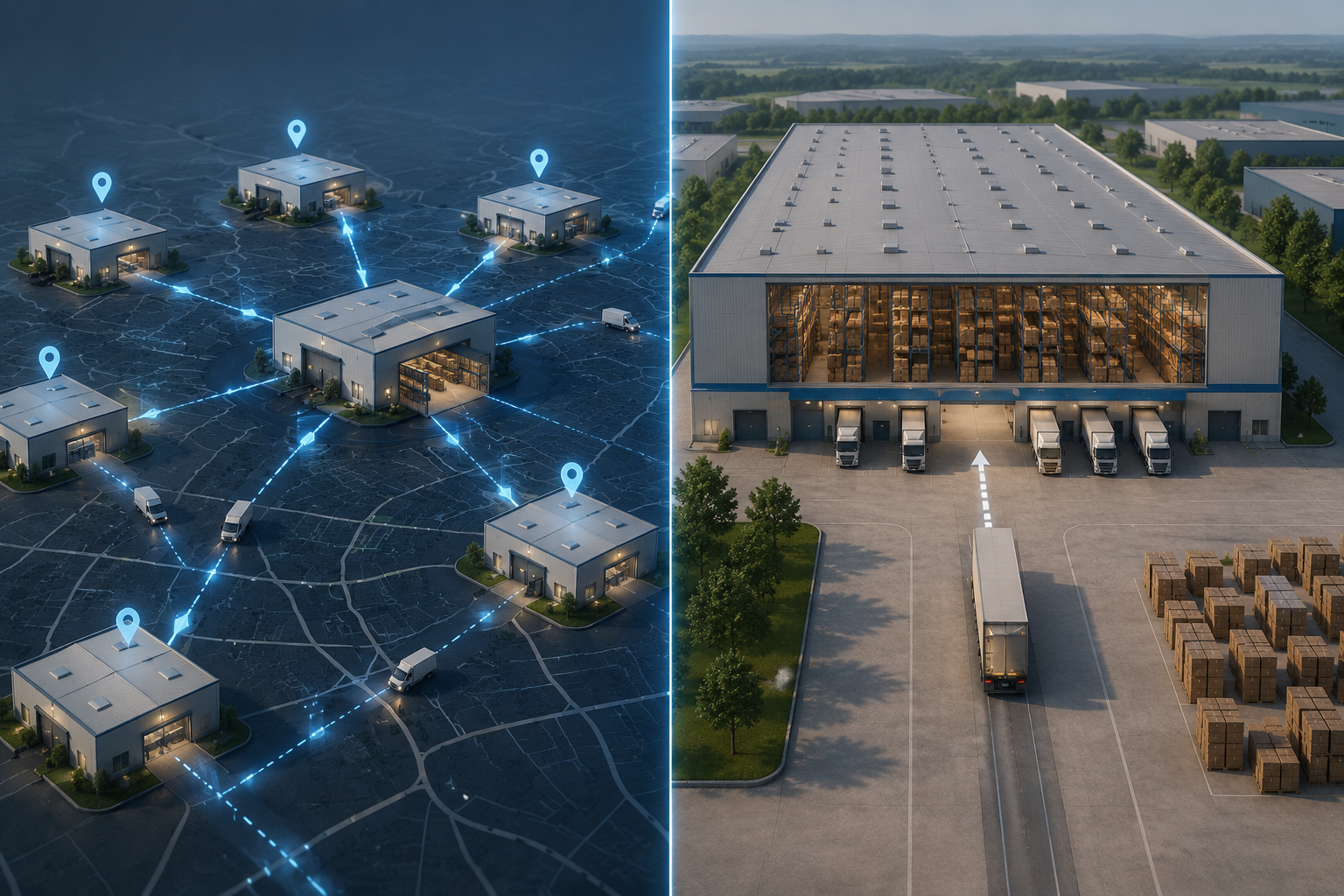
Quick commerce has emerged as a powerful demand driver for urban warehousing. Blinkit operates more than 1,500 dark stores in over 100 cities, Zepto has more than 1,000 in 40 cities, and Swiggy runs 1,062 shops spanning 127 cities. These micro-fulfillment centers, typically ranging from 2,000 to 10,000 square feet, require:
Hyper-local presence in dense residential neighborhoods
Advanced inventory management systems
24/7 operational capability
Flexible, modular spaces for rapid category expansion
This new category of demand is creating opportunities for developers who can provide smaller, strategically located spaces in urban cores complementing traditional large-format warehouses in peripheral locations.
Regional Hotspots: Where the Action Is
Mumbai Metropolitan Region: Mumbai reported the highest absorption of 18.6 million square feet in 2024, growing 82% compared to the previous year, attributed to improved intercity connectivity through Navi Mumbai airport and the rise of quick commerce.
Pune: Pune’s absorption increased by 85%, the highest rise among the top seven cities, driven by its strategic location between Mumbai and Bengaluru and strong manufacturing base.
NCR Delhi: With freight corridors like DMIC, WDFC, and EDFC enhancing connectivity, Delhi-NCR is poised to reach 98 million square feet of warehousing stock, supported by investors like IndoSpace, Ascendas, and ESR.
Bengaluru, Chennai, and Hyderabad: Southern markets continue to attract investment due to their robust IT/ITeS sectors, manufacturing clusters, and export-oriented industries.
Future Outlook: What’s Next for India’s Warehousing Sector
The trajectory is unmistakably upward. The Indian warehouse market is projected to reach USD 163.98 billion by 2034, driven by:
- Manufacturing Diversification: The China+1 strategy and government initiatives like PLI (Production Linked Incentive) schemes are attracting global manufacturers to India, creating sustained demand for industrial and logistics infrastructure.
- Technology Adoption: Automation, robotics, IoT-enabled inventory management, and AI-powered supply chain optimization are transforming warehouses into smart facilities, attracting tech-forward tenants willing to pay premium rents.
- Tier-2/3 City Expansion: As e-commerce and quick commerce penetrate deeper into India, secondary cities are becoming attractive destinations for decentralized fulfillment networks.
- Cold Chain Growth: Rising demand for perishables, pharmaceuticals, and temperature-sensitive goods is driving investment in specialized cold storage and refrigerated warehousing.
- Sustainability Focus: ESG considerations are increasingly important, with LEED/IGBC-certified green buildings commanding rental premiums and attracting socially responsible investors.
The Visvasa Advantage: Building for Institutional Excellence
At Visvasa, we’ve always believed that the future of warehousing lies in building for institutional excellence. Our development philosophy aligns precisely with the parameters that leading fund houses prioritize:
Strategic Land Banking: We acquire land in emerging logistics corridors before they become mainstream, offering our partners first-mover advantages and superior returns.
Rigorous Financial Modeling: Our projects are underwritten with institutional-grade financial discipline, ensuring sustainable returns and manageable risk profiles.
Grade-A Standards: From precision-leveled floors to comprehensive safety systems, we build facilities that meet or exceed international benchmarks, attracting blue-chip tenants.
Sustainability Leadership: Our commitment to green building practices and carbon-neutral operations
positions our assets for long-term value appreciation in an increasingly ESG-conscious investment landscape.
Operational Excellence: We provide best-in-class property management and tenant services, ensuring high occupancy rates and long-term lease renewals that maximize NOI.
By creating world-class, institutional-quality logistics parks, we’re not just attracting capital—we’re providing our customers with the infrastructure they need to compete in the global economy. We’re building the logistics future that the world’s most sophisticated investors are eager to fund.
Partner with Excellence
Are you an investor seeking a developer of institutional caliber?
Join hands with a team that understands what it takes to attract and retain global capital while delivering superior risk-adjusted returns.
Are you a business looking for world-class warehousing solutions?
Access Grade-A facilities in strategic locations, backed by institutional-quality development and management.
Reach out to our experts at Visvasa to discover how we can help you build your success on the solid foundation of modern logistics infrastructure.