Today’s supply chain warehouse is not merely a static storage facility; it is an active nerve center that determines the speed, efficiency, and market reach of a business. As consumer behavior transforms and digital channels expand, the “one-size-fits-all” model of warehousing has been rendered obsolete.
For companies that seek to maximize their supply chain in India’s hyper-competitive economy, the decision between an omnichannel and a warehousing model is a strategic one that can make or break their operational success.
This is a decision between two inherently distinct philosophies. One values consolidation and cost-effectiveness, whereas the other espouses flexibility and velocity. Deciding between them requires grasping the subtlety of each to make an educated choice that will be in sync with your long-term business objectives.
The Centralized Warehousing Model: The Power of Consolidation
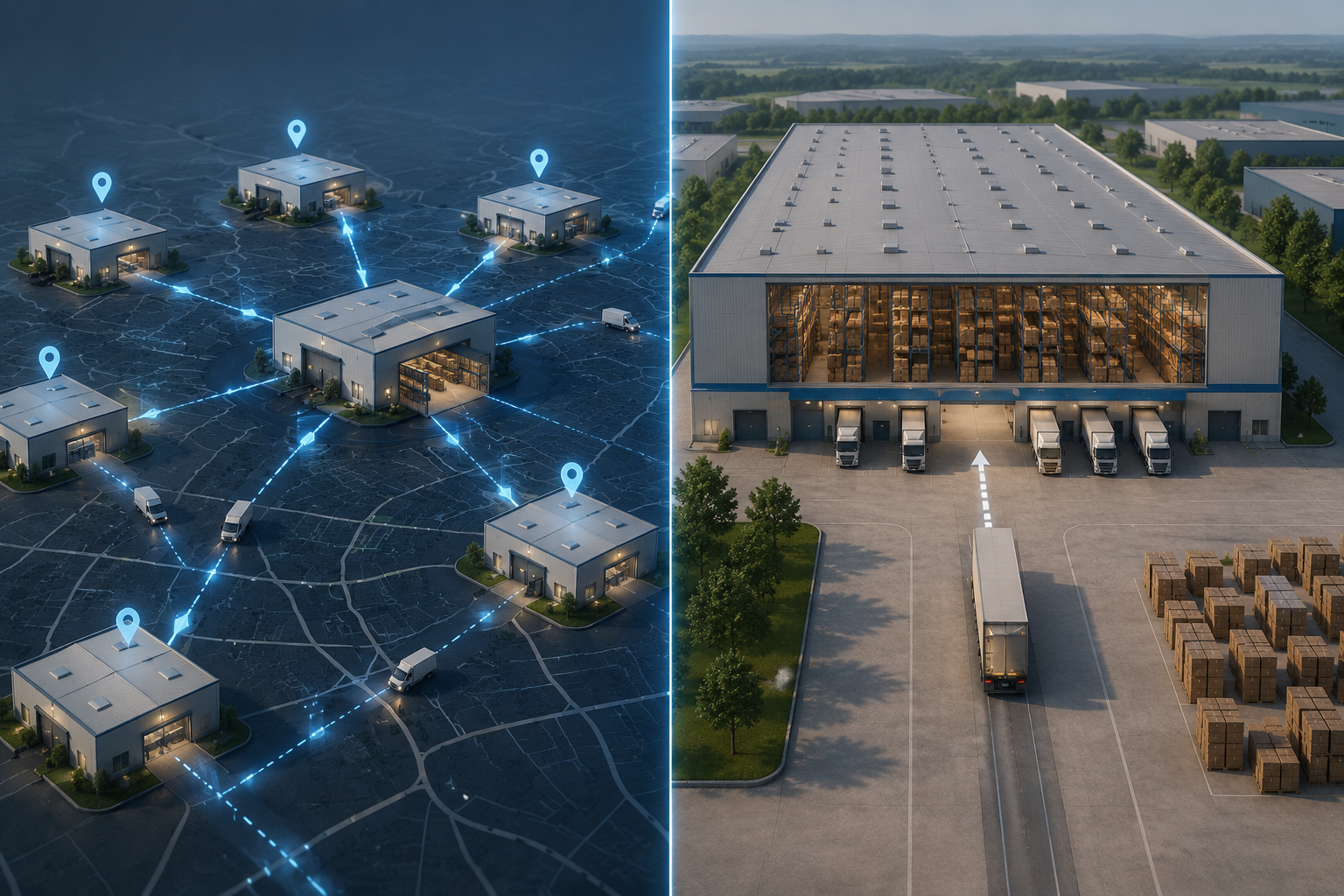
Centralized warehousing is the traditional, time-honored method of logistics. It is based on a straightforward, powerful axiom: economies of scale. Under this model, a company holds all or most of its inventory in one, big, well-located warehouse. This one warehouse is the central location from which all orders—either for a retail store or for direct-to-consumer shipment—are shipped.
Advantages of Centralized Warehousing
- Cost Savings: This is the main motivator for the centralized strategy. By keeping inventories in one place, a company can lower its real estate expenses considerably. It only takes one lease agreement, a minimal workforce, and one bill for utilities. Furthermore, it is less complicated and inexpensive to maintain one large facility compared to managing several smaller ones.
- Simplified Operations: With everything processed in a single location, inbound and outbound logistics, returns management, and quality control are simplified. There is no coordination between multiple facilities, diminishing complexity and room for error. This model is especially attractive to companies with a limited number of products or that serve a defined geographic region.
Disadvantages of Centralized Warehousing
- Last-Mile Latency: For a market such as India, where Tier 3 and Tier 2 cities are the drivers of much of e-commerce expansion, last-mile delivery is a significant issue. A central model, especially for a business running at a national level, can mean long transit times and increased shipping expense to remote consumers. For a company with a value proposition of fast delivery, this model can be disadvantageous to its competitiveness.
- Single Point of Failure: Relying on one central hub creates a single point of failure. A natural disaster, a labor strike, or an unforeseen operational disruption at this single location can bring your entire supply chain to a grinding halt. It can be crippling to your ability to fulfill any order.
The Omnichannel Warehousing Model: Designed for the New Consumer
The omnichannel warehousing strategy is a natural reaction to what today’s consumer wants—a uniform, end-to-end experience across touchpoints. It can be online, in-store, and mobile. The idea is to get the product as close to the customer as possible and cut transit time and expense.
Benefits of Omnichannel Warehousing
- Speed and Customer Experience: The biggest benefit is the capability to provide faster, more guaranteed delivery, a key differentiator in the world of e-commerce.
- Improved Supply Chain Resilience: A decentralized network breaks the single point of failure. This duplication ensures business continuity and offers a strong cushioning against surprises.
- Greater Scalability and Flexibility: As your organization expands in a new city or region, you can open up a new facility to serve that particular market without having to completely overhaul your entire network. This is perfect for companies with a diverse product line and broad geographic reach.
Disadvantages of Omnichannel Warehousing
- Increased Costs: Having more than one facility automatically results in increased real estate, labor, and operational expenses. Every place has its own crew, equipment, and upkeep, all of which can drastically raise your overall cost.
- Inventory Complexity: Having inventory at multiple locations can be a logistical headache. It needs advanced Warehouse Management Systems (WMS) to provide real stock visibility, avoid stockouts, and enable order routing optimization. Without such technology, you stand to lose on efficiency and poor inventory control.
- Redundancy of Resources: Omnichannel strategy can be the cause of duplication of resources, as each center must have its own equipment and staff. This can eat into some of the cost benefits achieved through quicker delivery and demands careful planning to remain effective.
Selecting the correct model: It’s Not a One-Size-Fits-All Solution
The omnichannel vs. centralized warehousing debate is not which model is “better” but which one is the appropriate fit for your company. The best model depends on a few important considerations:
Your Product and Customer Base:
- If your company sells large, non-perishable, or low-volume products (for example, industrial equipment), a centralized model will probably be more effective.
- For a company in a high-speed market such as e-commerce, Q-commerce, or consumer packaged goods (FMCG) where last-mile speed is everything, an omnichannel strategy is a competitive requirement.
Your Business Stage and Scale:
- Early-stage businesses or small-sized companies may find the centralized strategy more economical and easier to control in the early days.
- Large-scale established companies with national coverage and broad product offerings will realize huge benefits from the strength and agility of an omnichannel network.
The Visvasa Advantage: Building for Both Futures
At Visvasa, we understand that it is not an either-or and neither omnichannel nor centralized. The logistics future of India is a combination of both, tailored to the individual needs of each company. We are the masters at providing excellent, flexible warehousing options that allow companies to build and expand their optimal supply chain network.
Whether you need a massive, state-of-the-art facility for your central hub or a chain of smaller, strategically located warehouses for your last-mile services, our buildings are constructed to serve that purpose. We pair technology, sustainability, and superior location to create a real estate answer that is more than a warehouse, rather, it is a launching point for business growth.
With Visvasa, you’re not just reserving space; you’re a stake in a future-proofed logistics infrastructure to help you keep pace with the evolving needs of the market, whether you’re interested in consolidation or realizing a hyper-local customer experience. The optimal choice is one that gives you the competitive edge, and we’re here to help you build it.